
Last updated November 2, 2026
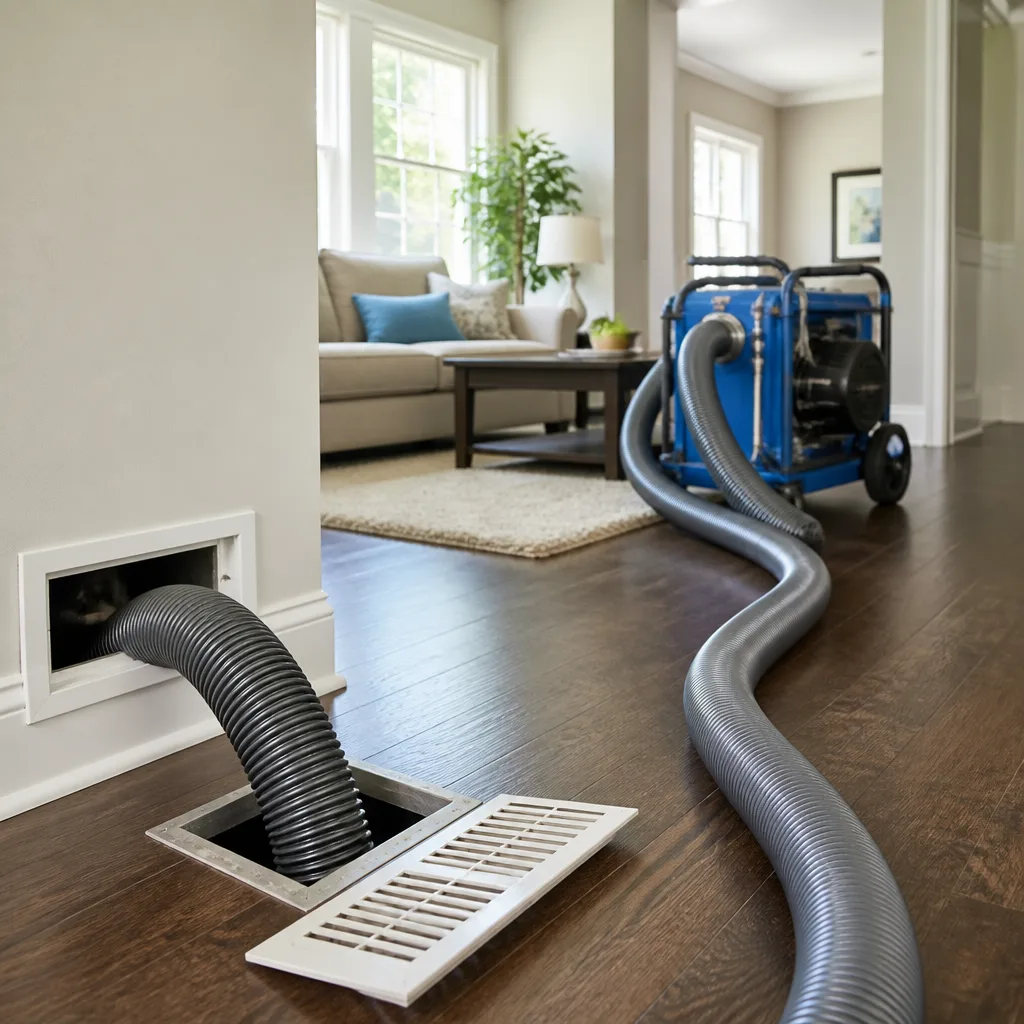 Whole-home duct cleaning
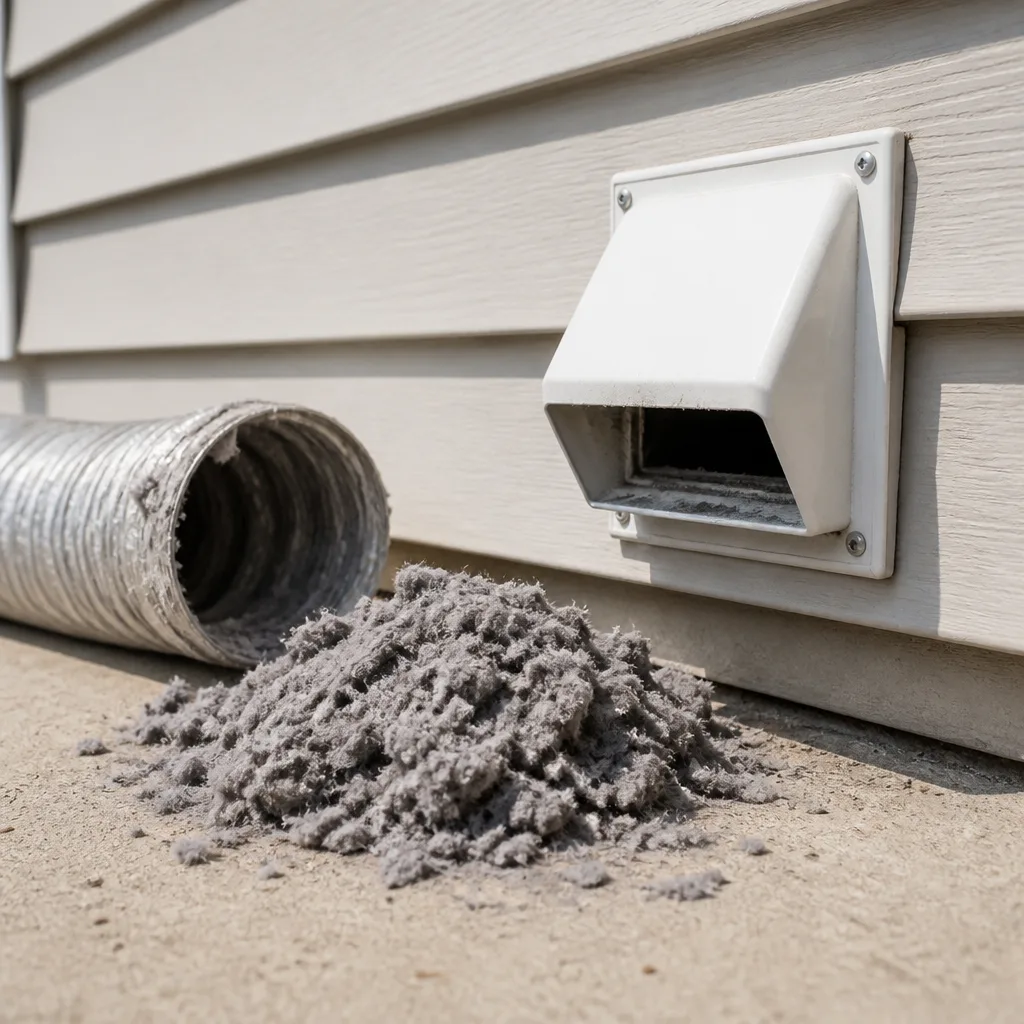 Dryer vent cleaning
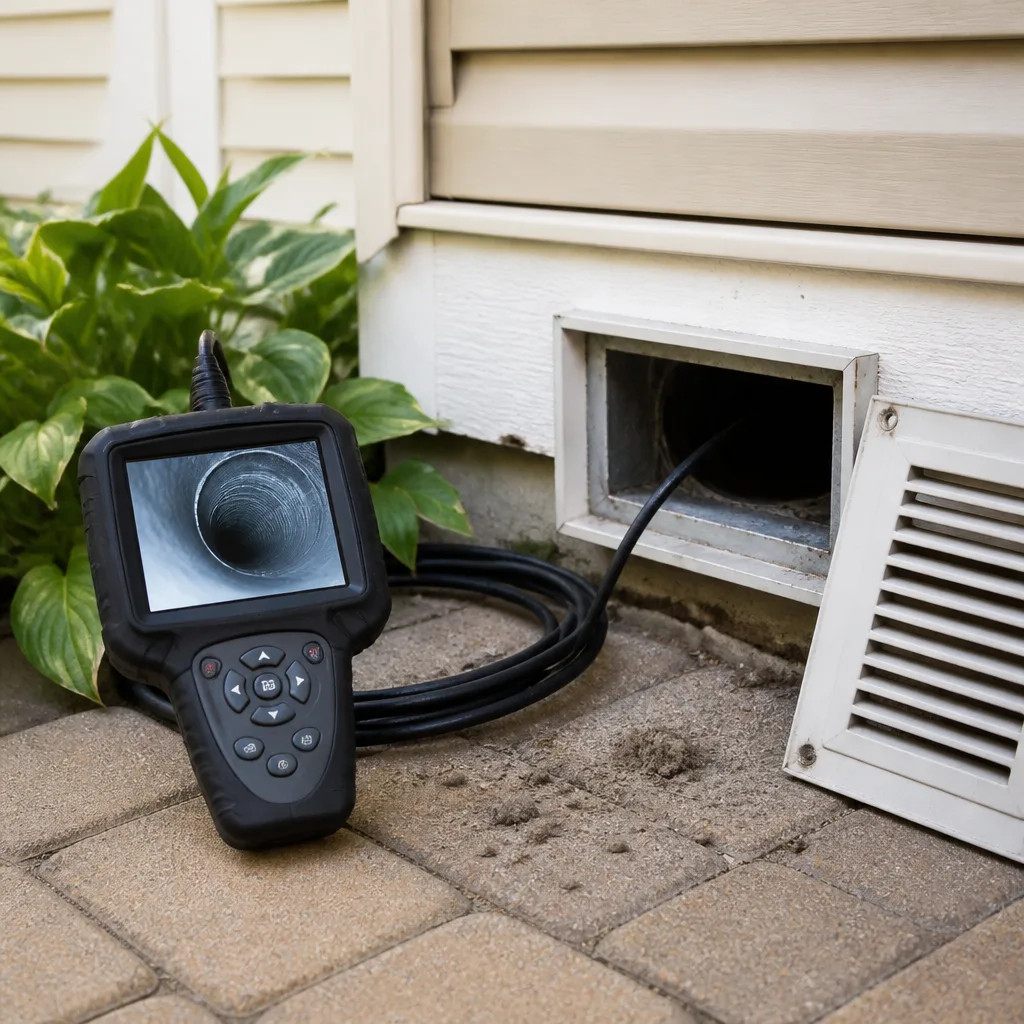 Camera inspection
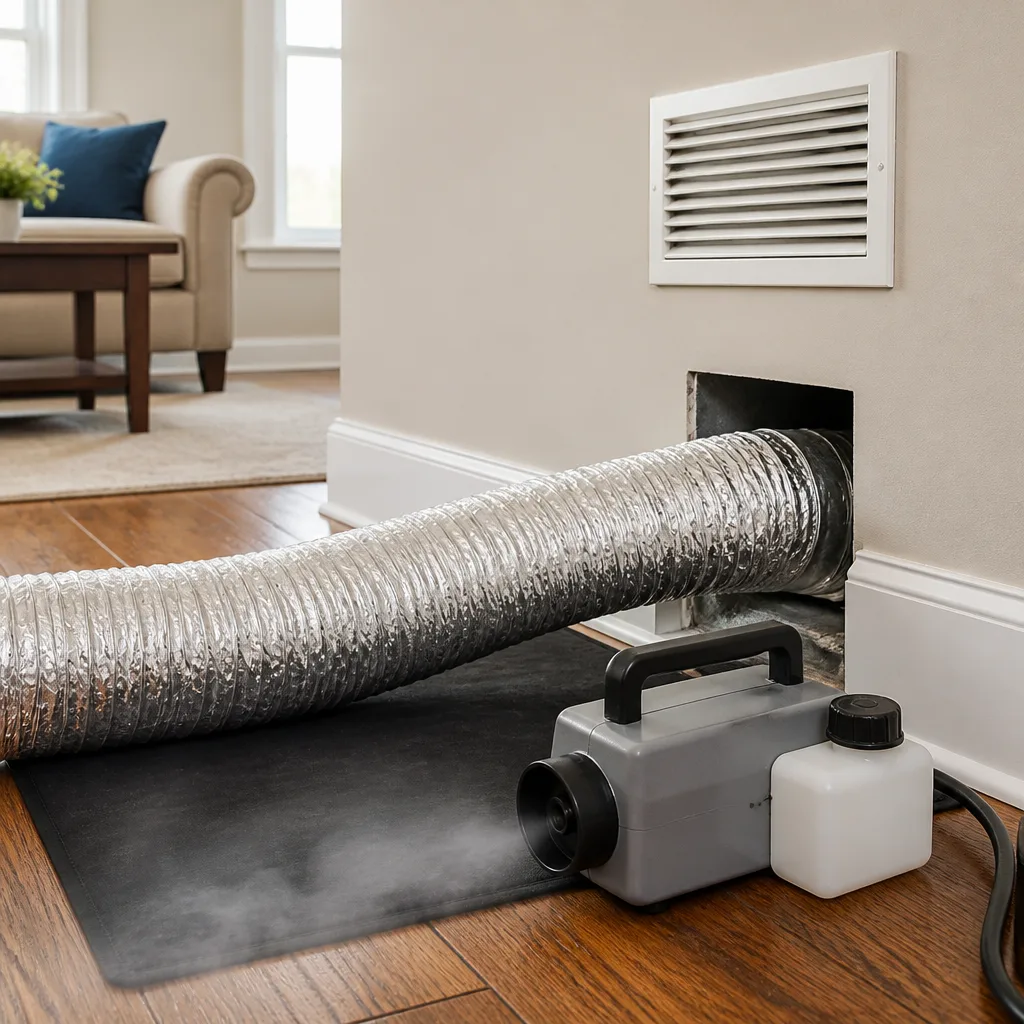 Sanitizing & deodorizing
Whole-system duct and dryer vent check with before-and-after photos - you see exactly what came out of your vents
That "$99 whole-house special" is a bait ad - the real number appears once they are in your hallway, or the "clean" is a shop-vac at the register. We photograph the inside of your ducts before and after instead.
Air Duct Cleaning Emergency Preparedness Guide for San Jacinto Homes
When the 2023 Riverside County storm series pushed water into crawlspaces across San Jacinto, duct systems that sat damp for 72 hours began growing mold colonies within the week. Most affected homeowners didn’t think to inspect their HVAC systems until respiratory symptoms appeared months later. That lag between event and response is the single costliest pattern we see in this trade, and it’s almost always preventable. This guide – along with our more guides & resources – lays out exactly what to do in the first hours and days after three distinct San Jacinto emergency scenarios: wildfire smoke, flooding and moisture intrusion, and seismic events. You’ll learn what to shut down, what to check, what to leave alone, and when to call someone who carries commercial-grade equipment rather than a shop vac.
Quick Answer
Air duct cleaning emergencies in San Jacinto fall into three categories: wildfire smoke contamination, flood or moisture intrusion, and post-earthquake duct damage. The first 24 to 72 hours determine whether you need a cleaning or a more involved repair or remediation. You should shut the HVAC system down if you suspect smoke, water, or structural damage in the ductwork, upgrade to a high-MERV filter temporarily, and call a duct professional who can mobilize inspection equipment rather than a general handyman. For San Jacinto homeowners, Duct Cleaning San Jacinto home resources and a professional Air Duct Cleaning in San Jacinto assessment are the fastest route from crisis to a documented, verifiable fix.
Styles & brands we work with
- Whole-home duct cleaning
- Dryer vent cleaning
- Camera inspection
- Sanitizing & deodorizing
Table of Contents
- Wildfire Smoke: The First 24 Hours and the 48-72 Hour Inspection Window
- Flood and Moisture Events: The 72-Hour Mold Window
- Post-Earthquake Duct Inspection: What Breaks and Where to Look
- How to Pre-Qualify an Emergency Duct Contractor Before You Need One
- Temporary Air Quality Measures That Actually Work
- Why Equipment Matters in an Emergency Response
- Common Mistakes to Avoid
- When to Call a Professional
Wildfire Smoke: The First 24 Hours and the 48-72 Hour Inspection Window
San Jacinto sits downwind of some of the most active wildfire corridors in Riverside County. When smoke settles over the valley, your HVAC system becomes either your best filter or your family’s most efficient smoke distribution network depending entirely on how you respond in the first day. Smoke particles are not uniform. They range from visible ash down to sub-micron particulates that pass through standard fiberglass filters without slowing down. Once those fine particles enter the return side of your system, they coat the blower wheel, the evaporator coil, and the interior surfaces of the supply ducts. Then, every heat or cooling cycle re-aerosolizes them into your living space for weeks after the outdoor air clears.
First 24 Hours: Immediate Protocol
- Set the thermostat fan to AUTO, not ON. The ON setting runs the blower continuously and pulls smoke-laden air through the system around the clock. AUTO cycles only when the system calls for heating or cooling, minimizing exposure.
- Replace your filter with the highest MERV rating your system can handle. A MERV 13 filter will capture a meaningful fraction of smoke particulates. Check your furnace or air handler documentation; some older San Jacinto systems can’t handle the airflow restriction of MERV 13 without overheating. MERV 11 is a safe fallback.
- Seal windows and doors, and close fresh-air intake dampers if your home has them. Many newer San Jacinto tract homes have outdoor air intakes tied to whole-home ventilation. If you have a Honeywell or Aprilaire ventilation controller, set it to recirculate or off during heavy smoke events.
- Don’t run bathroom or kitchen exhaust fans continuously. They create negative pressure that pulls smoky outdoor air through any gap in the building envelope.
48-72 Hours After Smoke Clears
Once outdoor air quality returns to normal, the work begins. Smoke residue inside ducts doesn’t dissipate on its own, and a standard filter change won’t remove what has already settled downstream of the filter. That’s when you schedule a visual inspection. The inspector should be looking for: smoke staining on the blower housing, gray or black residue on the evaporator coil fins, and visible soot lines inside the supply plenum. In our experience in San Jacinto, homes within five miles of any burn scar during a major event almost always show measurable residue even when the homeowner noticed no indoor odor. The cleaning itself – best handled through our Air Duct Cleaning services – requires mechanical agitation of the duct interior surfaces with a rotary brush system, with the loosened particulate captured by a HEPA-rated negative-air vacuum. This is not a task for a portable shop vac.
Flood and Moisture Events: The 72-Hour Mold Window
Water in a crawlspace or slab foundation in San Jacinto doesn’t stay in the crawlspace. The ductwork runs through that same environment, and flex duct or insulated metal duct that sits in damp conditions will wick moisture into the air stream. The rule we operate by is simple: mold begins colonizing damp fibrous materials within 48 to 72 hours. If your ducts were exposed to floodwater, standing water, or sustained high humidity from a leak, you have about three days to get a professional assessment before the problem shifts from moisture to microbiology.
How to Assess Whether Your Ducts Got Wet
- Look at the crawlspace or basement first. If there’s a visible water line on the foundation walls or the soil is saturated, assume the ducts were exposed at some point.
- Check for sagging flex duct. Waterlogged insulation wrap adds weight and causes visible drooping between supports. This is a red flag that the insulation is saturated.
- Smell the return vents when the system kicks on. A musty, earthy odor that intensifies during system operation strongly suggests microbial activity inside the ducts or the air handler.
- Inspect the registers and grilles. Surface rust, water stains, or bubbling paint around supply registers in floor outlets often indicates moisture traveled through the duct.
Cleaning vs. Remediation: The Line That Matters
If the moisture event was brief and the ducts dried within 72 hours, a professional cleaning with antimicrobial treatment may be sufficient. But if the ducts sat damp longer, if the water came from flooding (which carries pathogens and sediment), or if visible mold growth is present on duct surfaces or insulation, you’re beyond cleaning. That’s a remediation scenario requiring containment, air scrubbing, and possibly duct section replacement. Abatement Technologies equipment is built for this exact situation: HEPA air scrubbers that remove airborne spores during the work and negative-pressure containment that prevents cross-contamination of the rest of the home. A company that shows up to a mold call with only a vacuum and a spray bottle is not equipped for the job. San Jacinto homeowners should ask pointed questions about what containment equipment will be deployed before anyone starts cutting into ductwork.
Post-Earthquake Duct Inspection: What Breaks and Where to Look
San Jacinto sits within the San Jacinto Fault Zone, which produces the kind of shaking that separates duct joints, pulls flex runs off their collars, and shifts plenums away from the air handler. The damage is almost never visible from the living space. Homeowners who skip a post-quake inspection often discover the problem months later when their energy bills spike or one room stops receiving conditioned air entirely. A disconnected return duct in an attic means the system is pulling 140-degree summer air through a three-inch gap instead of through the filter. The compressor works harder, the coil loads up with dust, and the filter bypassed entirely.
Seven-Point Post-Earthquake Inspection Checklist
- Turn the system off at the thermostat and the breaker. Safety first; you’ll be working near the air handler and potentially in the attic.
- Access the attic or mechanical closet. Bring a flashlight, not a phone light. You need a focused beam to see into the gap between duct collars and plenum openings.
- Inspect the air handler connections. The supply plenum and return drop are the highest-torque points during shaking. Look for a visible gap, shifted alignment, or torn foil tape at the connection.
- Check flex duct runs at both ends. Flex duct is secured with plastic zip ties or metal bands over a sheet metal collar. Shaking can pull the inner liner off the collar while the outer insulation jacket stays roughly in place. You must feel for the connection, not just look at it.
- Inspect damper assemblies. Volume dampers are thin metal blades on a pivoting rod. A jolt can bend the blade or pop the rod out of its bearing. A damper that’s stuck closed explains a suddenly dead room.
- Look for kinked or collapsed flex sections. Slab movement or attic shifting can compress a flex run. Air doesn’t go through a kink; it backs up and finds the path of least resistance.
- Check the condensate line and drain pan. A shifted air handler can throw the drain slope off, leading to water pooling in the pan and eventually overflowing or growing biology.
If you find any of these issues, the fix may be a simple reseal or a full Air Duct Repair in San Jacinto job depending on what you’re looking at. Duct tape is not a repair. Sheet metal connections need to be mechanically fastened and sealed with mastic or UL-listed foil tape. Flex duct needs a properly sized draw band or nylon zip ties rated for HVAC use, with the connection tested by hand before the system cycles back on.
How to Pre-Qualify an Emergency Duct Contractor Before You Need One
The worst time to start vetting a duct contractor is at 7:00 PM on a Sunday when your crawlspace is full of water and you’re making panicked phone calls. San Jacinto homeowners should do this homework now, before the fire season, flood watch, or the next fault slip. The questions below – and our Air Duct Cleaning Maintenance Checklist for San Jacinto Homeowners – will quickly separate specialist firms from generalists who clean what they can reach but don’t carry the equipment to inspect, contain, or repair what they can’t.
The Five-Question Pre-Qualification Call
- “What cleaning equipment do you run, and is it HEPA-rated at the point of collection?” The answer you want includes a rotary brush agitating system and a negative-air vacuum with HEPA filtration. The answer you don’t want is “we use a truck-mounted vacuum and a standard filter.”
- “Do you have containment equipment for mold or contamination work?” Companies that carry Abatement Technologies or equivalent air scrubbing and containment gear have remediation-level capability. Companies that pause on this question probably don’t do that kind of work, which means they may not recognize when it’s needed.
- “Can you inspect the full duct system, including the supply side, during the job?” A legitimate answer includes a visual inspection of the air handler, coil, both plenums, and representative access points into the duct runs. If they can’t describe how they’ll see inside the ducts, they’re not seeing inside the ducts.
- “Do you handle duct repairs during the same visit if you find damage?” When you need cleaning and they discover a disconnected run or a crushed flex section, you want one call, one mobilization, one resolution. A company that has to refer you elsewhere adds days to an emergency timeline.
- “What’s your typical response time for an emergency call in Riverside County?” Be realistic: same-day service during a wildfire or flood event is rare for any legitimate operator. What you’re listening for is a defined workflow, not a vague promise. A firm that says “we’ll get you scheduled, inspect within 24 to 48 hours, and bring the equipment the job requires” is being honest. A firm that overpromises same-day response during a regional event is not.
Temporary Air Quality Measures That Actually Work
While you’re waiting for a professional, there are a handful of things you can do that genuinely reduce your exposure and slow the spread of contamination. There are also several things homeowners do that only waste money or, worse, make the situation harder to fix. Let’s separate them.
What Actually Works
- Run a portable HEPA air purifier in the occupied rooms. Place it in the room where people spend the most hours, usually the bedroom. A properly sized unit will turn over the room’s air several times per hour and capture a meaningful fraction of particulates that have already entered the space.
- Close the supply register dampers in unused rooms. If the HVAC must run, concentrating the conditioned air into fewer rooms lets you close off the most contaminated branches if you know where they are.
- Run the system fan continuously with a fresh high-MERV filter during smoke events only. This is the one exception to the AUTO setting guidance. Once the worst smoke has cleared, continuous fan operation helps filter residual indoor particulate, provided the filter is high-MERV and you replace it every two to four weeks during the recovery period.
- Isolate the HVAC system entirely and use window or portable AC units in the affected rooms. This is heavy-handed but effective in flood scenarios where running the central system would distribute spores from a contaminated branch to the whole house.
What Doesn’t Work
- Register filter pads. These thin, stick-on filters fitted over supply registers restrict airflow and stress the blower. They capture a negligible fraction of airborne particulate.
- Scented air fresheners or candles. These add volatile organic compounds to the air. They mask odor while doing nothing to remove the source. You’re not fixing the problem; you’re adding chemistry.
- Closing the windows and hoping for the best. If your ducts are already contaminated, the problem is inside the building envelope. Closing the windows just keeps the HVAC system circulating the contaminated air.
- Running a dehumidifier in the living room while the crawlspace stays saturated. The moisture that matters is under the house, not in the den. The ductwork doesn’t care what the living room relative humidity is when it’s sitting in a damp crawlspace.
Why Equipment Matters in an Emergency Response
There’s a reason we lead with the equipment. The difference between a professional cleaning and a surface-level pass is the difference between agitating the contaminants off the duct walls and simply vacuuming what’s loose. Most of what accumulates on duct interior surfaces during a smoke event, a flood, or years of neglect is adhered to the surface. It has to be mechanically removed. A rotary brush system like the Rotobrush we run on every cleaning job spins stiff bristles against the full interior circumference of the duct while the vacuum side of the machine pulls the loosened debris out of the air stream. That’s the key: you’re not just brushing. You’re brushing and extracting simultaneously, so the debris doesn’t just get knocked loose and redeposited downstream.
Nikro HEPA-rated vacuum equipment closes the loop. All the air that exits the vacuum unit passes through HEPA filtration before returning to your home. That matters during wildfire remediation, when the particulate you’re extracting is finer than what a standard vacuum filter will catch. It matters in mold scenarios too. And it matters when you have a homeowner with allergies or respiratory sensitivity who can’t afford to have the cleaning process itself make the indoor air worse.
For homes with whole-home air quality platforms, particularly Honeywell and Aprilaire systems, the cleaning protocol has to be built around your specific system. Integrated IAQ platforms include electronic air cleaners, UV lights, ventilation controllers, and sensor-driven fan cycling. Cleaning the ducts while ignoring or damaging these components isn’t a system-level job. Compatibility with these platforms isn’t a marketing claim; it’s about knowing where the components sit in the air stream and working around them. If your San Jacinto home has an Aprilaire filter cabinet at the air handler, the technician needs to pull and inspect that cabinet during the cleaning, not work around it.
Common Mistakes to Avoid
- Waiting until symptoms appear to act. By the time someone in the household develops a persistent cough or sinus inflammation, the contamination has been circulating for weeks. San Jacinto homeowners who act within the 48-72 hour window after a flood or smoke event almost always avoid the worst outcomes.
- Hiring a general handyman for a duct system problem. Duct systems are sealed, balanced, and integrated with the HVAC equipment. A handyman with a shop vac can reach the first few feet of the return. That is not a duct cleaning.
- Believing a low per-vent price advertised online. The duct cleaning industry has a well-earned reputation for bait-and-switch pricing. A company quoting you $49 and then finding “mold” in every vent when they arrive is a known pattern. Ask for a flat price per system, agreed before work starts, with a written scope.
- Running the HVAC system before inspection after a flood or earthquake. The system is blown: every cycle distributes the problem further. Shut it down at the thermostat and the breaker until someone qualified has looked at it.
- Skipping the post-repair inspection. After a cleaning or a repair, ask to see the before-and-after photos. A legitimate operator documents the work. If the company can’t show you what the inside of your ducts looked like, they didn’t look.
- Ignoring the dryer vent during an emergency response. Lint-clogged dryer vents are a fire risk that compounds when the household is distracted by a larger emergency. A dedicated dryer vent cleaning in San Jacinto should be part of any whole-home air safety plan.
When to Call a Professional
Call a duct professional when you notice any of these specific conditions: visible mold growth on or around registers, a persistent musty smell that intensifies when the system cycles on, visible water damage or water staining around the air handler or in the crawlspace, black or gray soot deposition on register vanes after a wildfire, a sudden unexplained spike in your energy bill following an earthquake, or any room in the house that stopped receiving airflow. These are not maintenance items. They’re system failures with health and safety consequences. Duct Cleaning San Jacinto offers free estimates in San Jacinto and serves the surrounding Riverside County area with professional-grade Rotobrush and Nikro equipment. Call (866) 569-6948 to schedule an inspection and get a flat price per system before any work begins.
See the difference
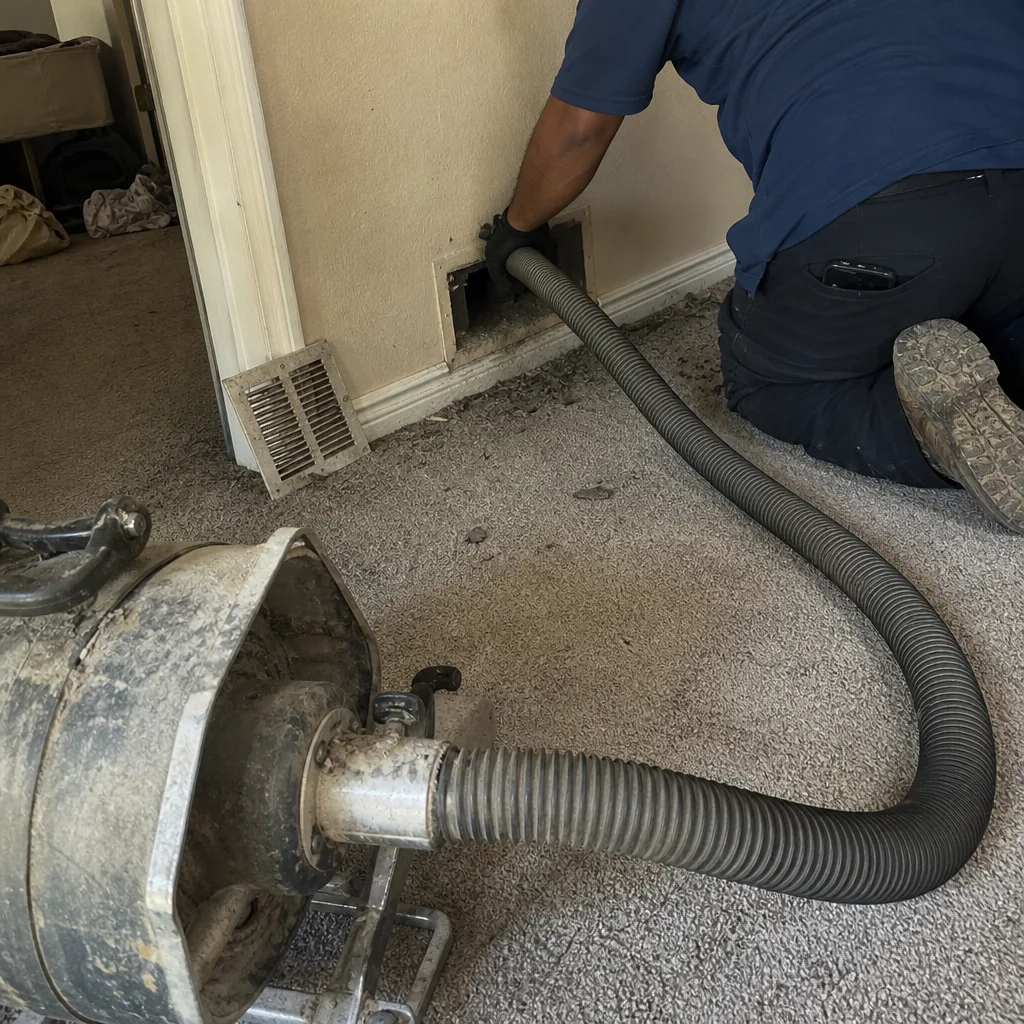 Before
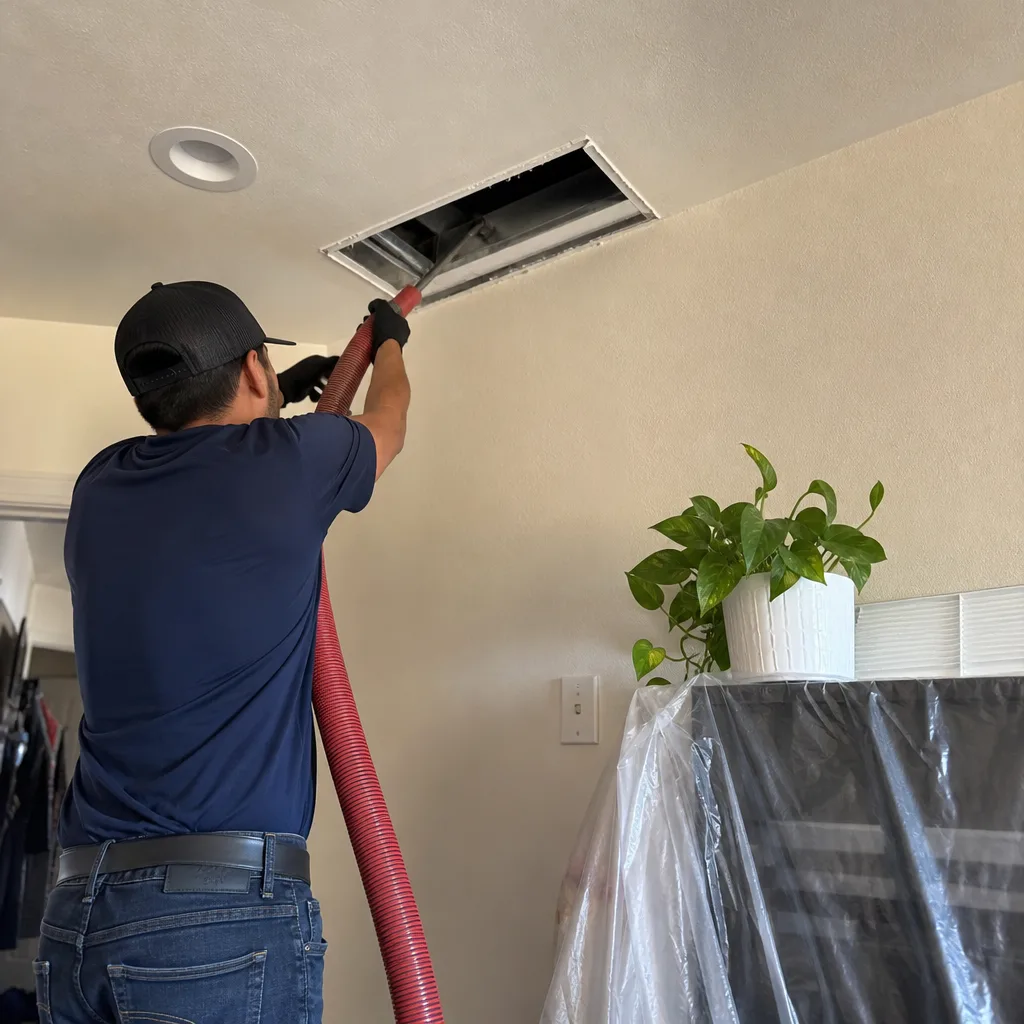 After
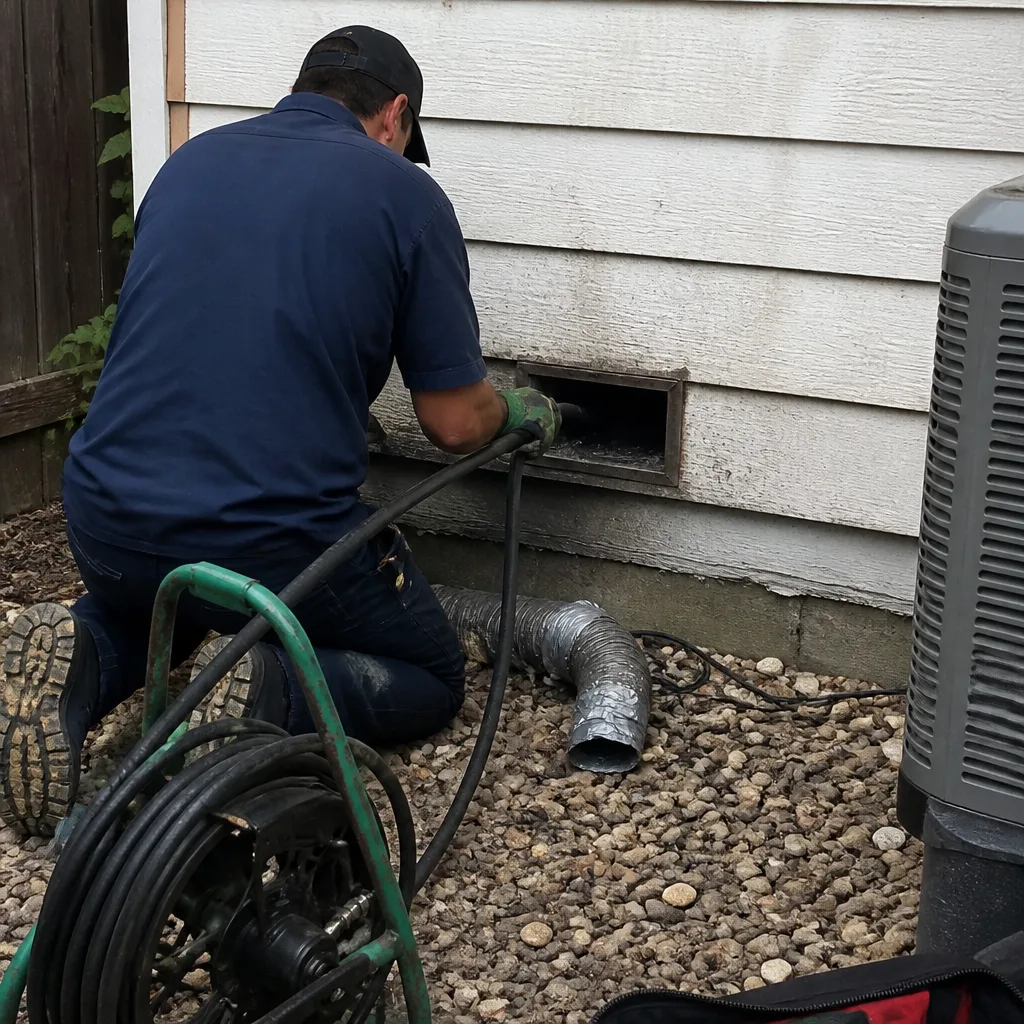 Before
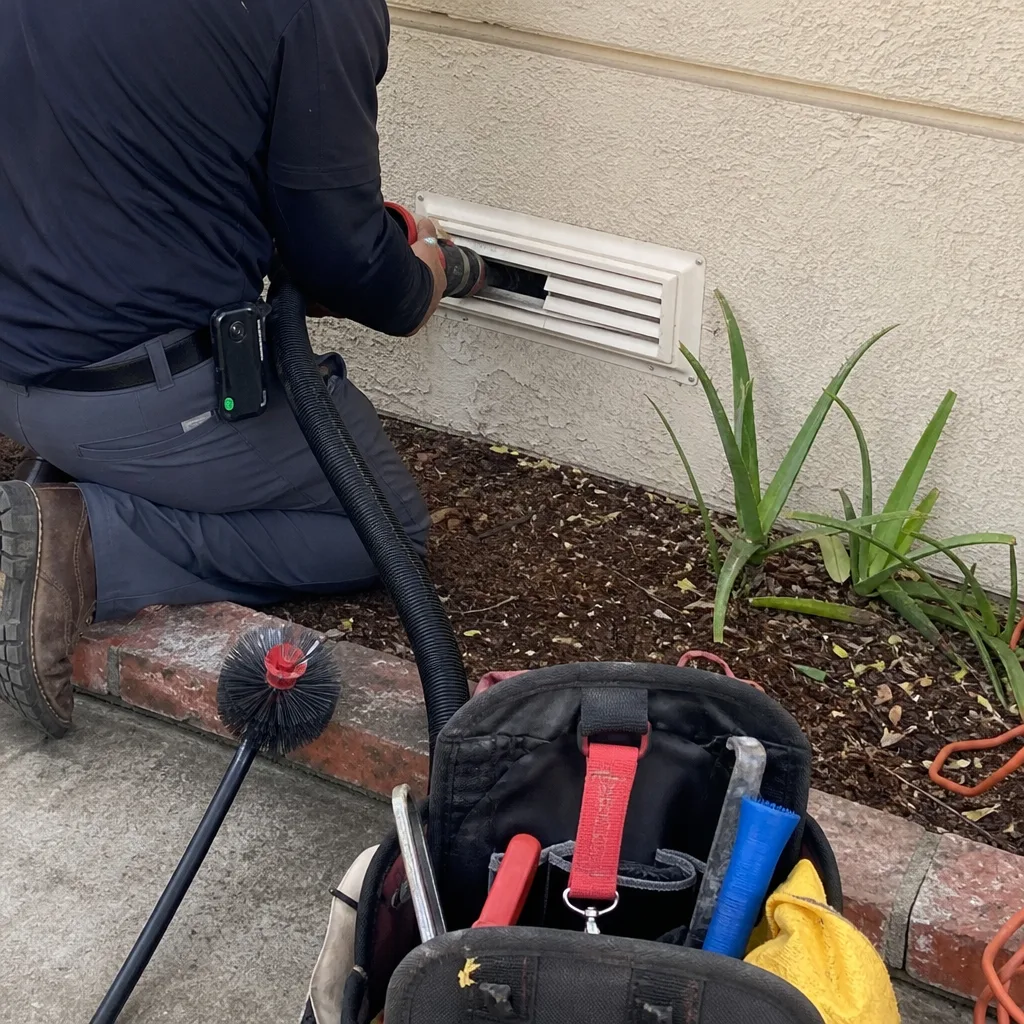 After
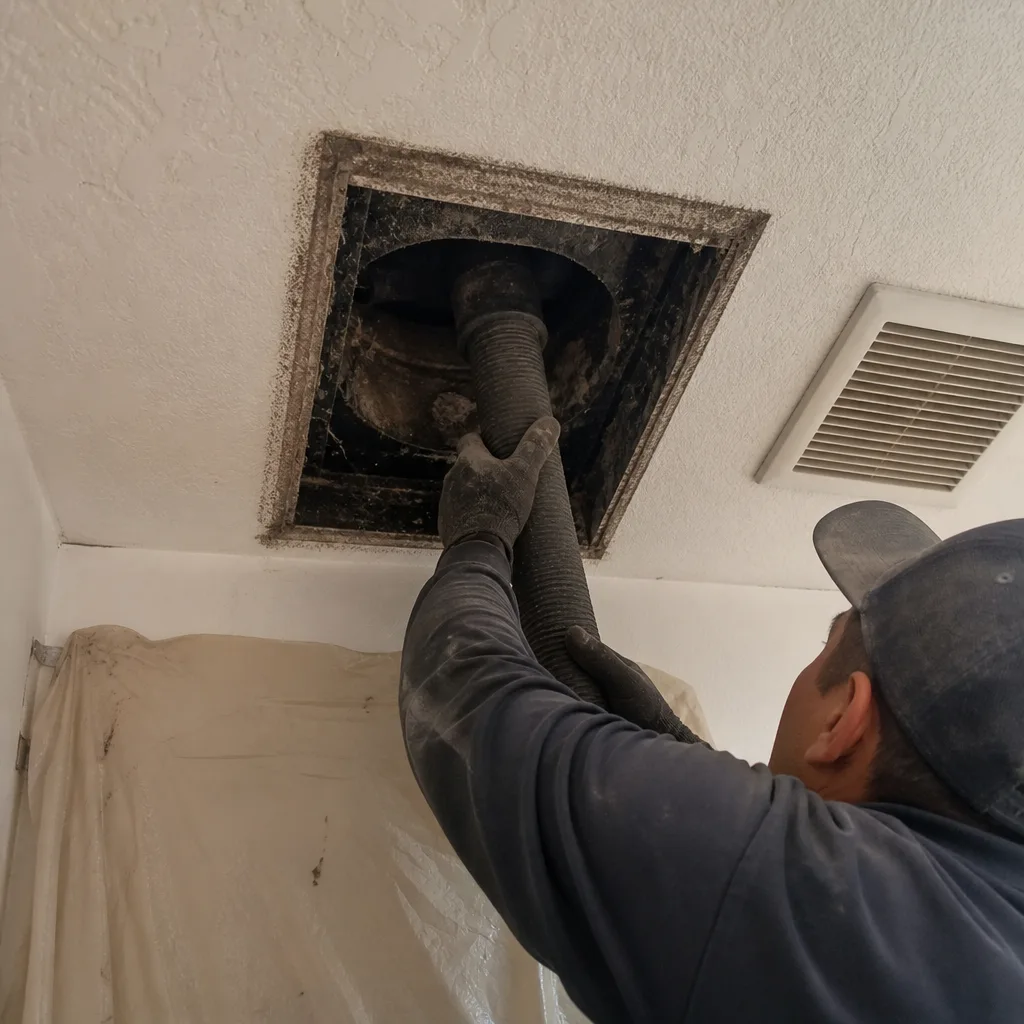 Before
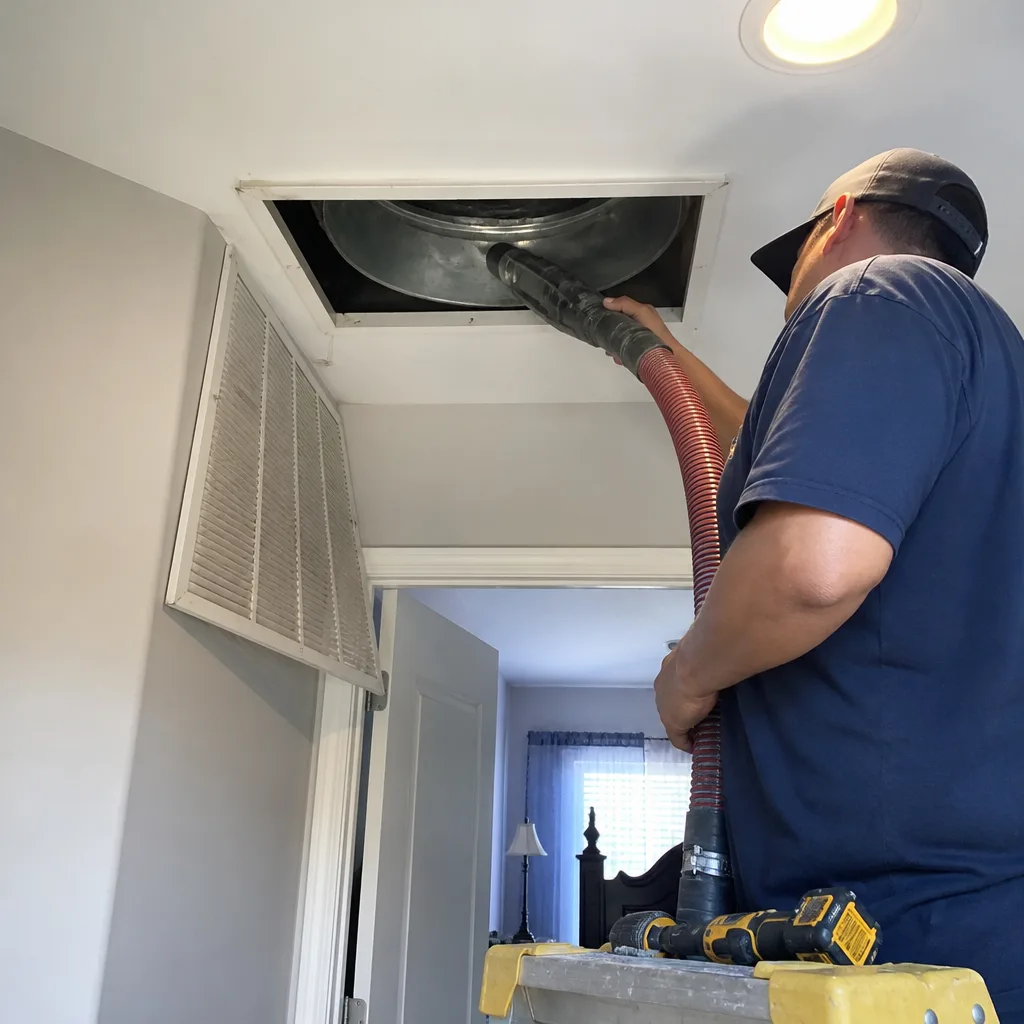 After
Frequently Asked Questions
You should schedule a duct inspection within 48 to 72 hours after outdoor air quality returns to normal. The inspection will determine whether cleaning is necessary, and a professional cleaning with HEPA filtration can remove smoke particulate that has settled on duct surfaces and in the air handler.
Yes. Flex duct with fiberglass insulation wicks moisture upward from a damp crawlspace even when the system isn’t operating. The damp insulation creates the conditions for mold growth inside the duct wrap, and once the system runs again, spores distribute throughout the home. Call (866) 569-6948 for a crawlspace moisture assessment and duct inspection.
The deciding factors are the duration of moisture exposure, the water source, and the presence of visible microbial growth. If the ducts were wet for more than 72 hours, if the water was floodwater, or if there’s visible mold on duct surfaces or insulation, remediation with containment and air scrubbing is required. A cleaning alone will not resolve the problem. Free estimates are available in San Jacinto; call (866) 569-6948.
You should inspect the supply and return connections at the air handler, both ends of every flex duct run, all volume damper assemblies, and any visible duct joints. Look for gaps, shifted alignment, torn tape, and kinked flex sections. If you can’t safely access the attic or aren’t sure what you’re looking at, schedule a professional inspection.
Whole-system air duct cleaning in the San Jacinto and Riverside County market typically ranges from about $350 to $600 for a standard single-family home with one air handler and 10 to 15 registers. Remediation work involving mold containment and antimicrobial treatment runs higher, and repairs are priced separately based on what’s found. The key is a flat price per system agreed before the work starts. Call (866) 569-6948 for an exact quote.
Cheaper quotes often come from companies that use a standard portable vacuum without HEPA filtration, skip the supply side of the system, use minimal agitation, or plan to upsell you on “mold treatments” once they’re in the door. You’re not comparing the same service. A company running Rotobrush mechanical agitation and Nikro HEPA extraction is doing work that takes longer and costs more because it’s a complete system cleaning, not a vent vacuuming.
The Bottom Line
San Jacinto’s exposure to wildfire smoke, flood events, and seismic activity means your duct system is under threat from three distinct emergency scenarios you can’t schedule around. In every case, the first 48 to 72 hours matter most, and the response protocol is the same in spirit: shut the system down, assess the exposure, and call a professional who carries the right equipment before the problem compounds. The difference between a quick recovery and a months-long health and repair saga comes down to two things: how fast you act and whether the company you call has the tools to do the job properly. For San Jacinto homeowners, that means professional-grade equipment, HEPA filtration, documented work, and a flat price agreed before work starts. Call (866) 569-6948 for a free estimate, and put the number in your emergency contacts before the next event, not after.
Written by the team at Duct Cleaning San Jacinto, serving San Jacinto since 2015.