
Last updated November 2, 2026
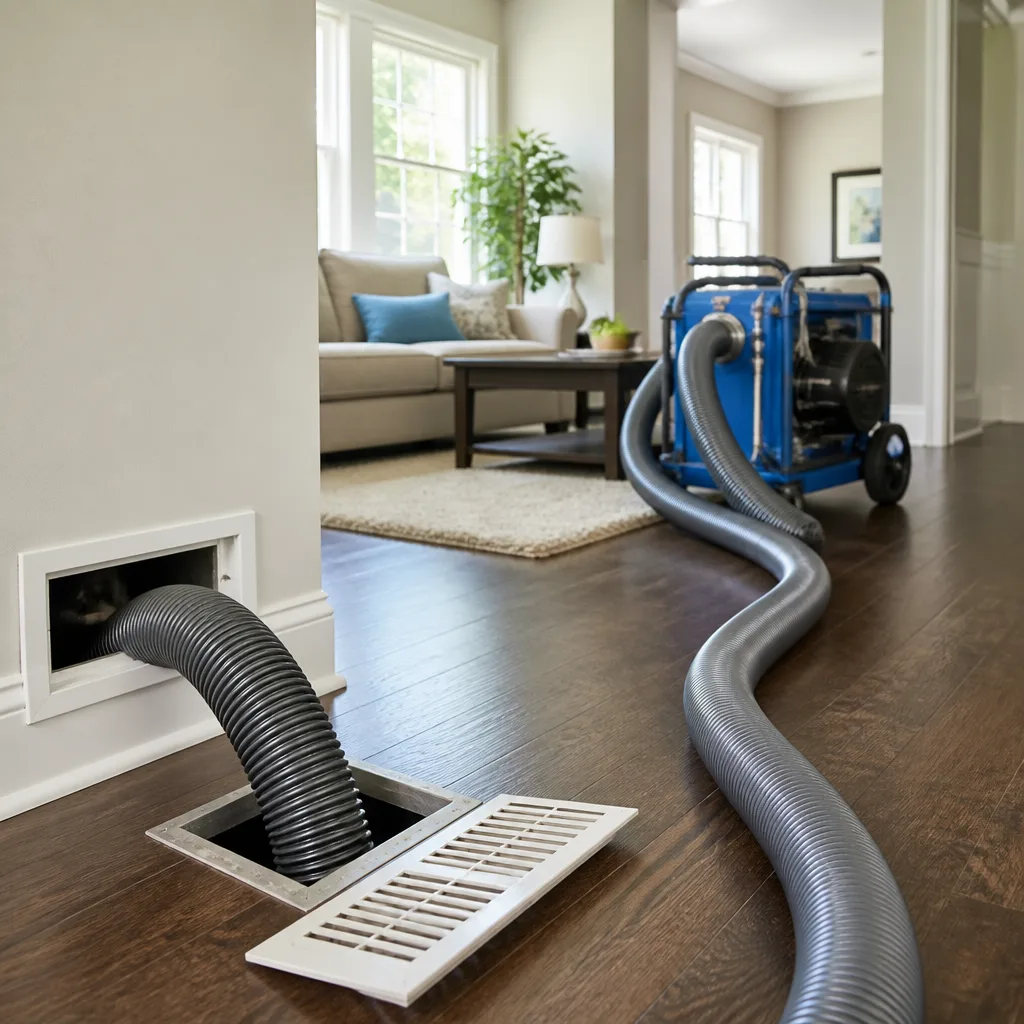 Whole-home duct cleaning
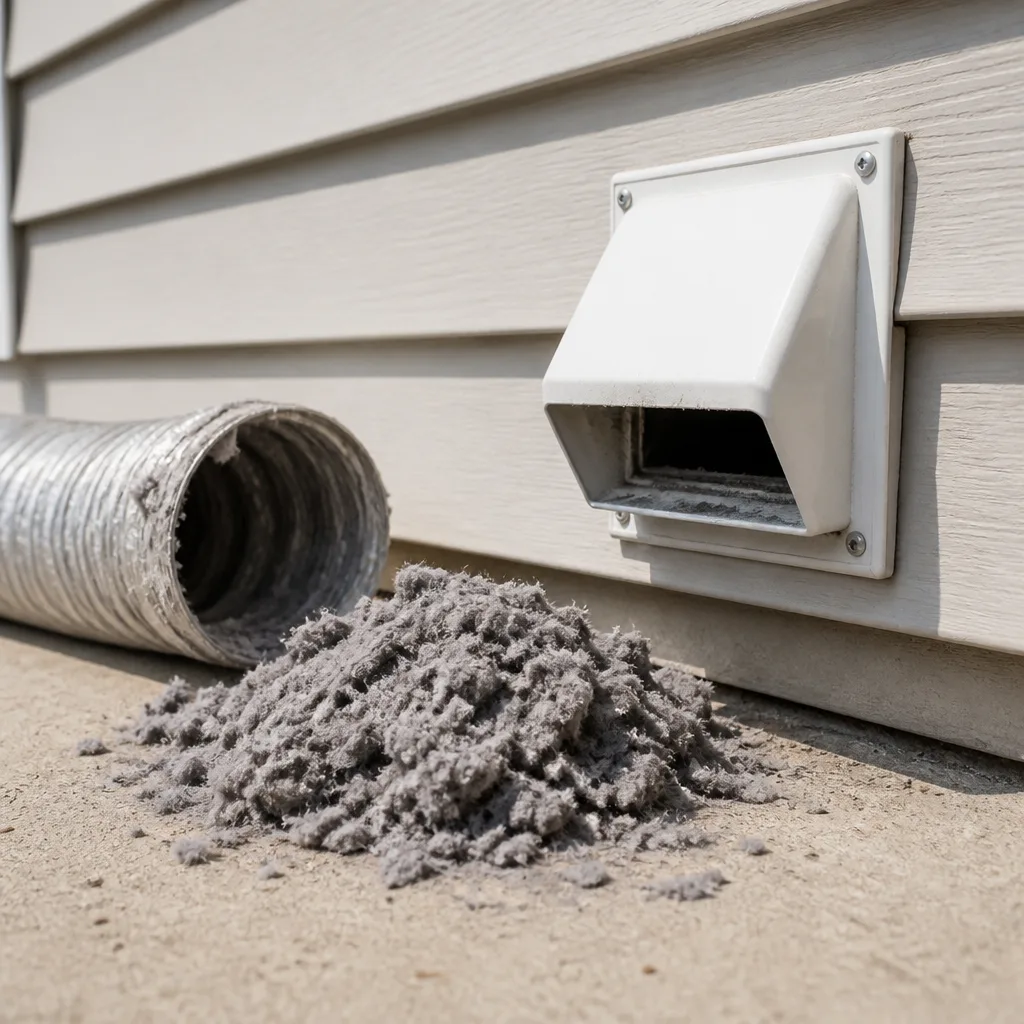 Dryer vent cleaning
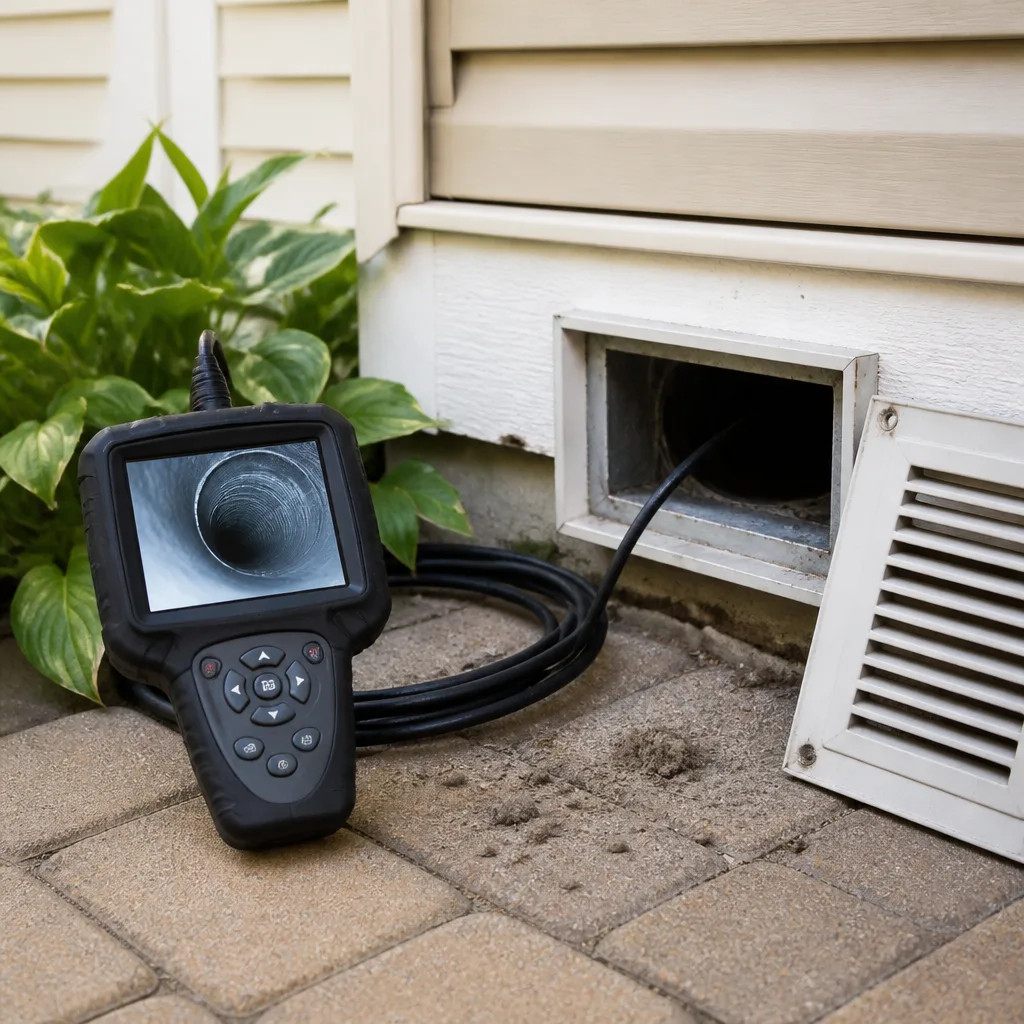 Camera inspection
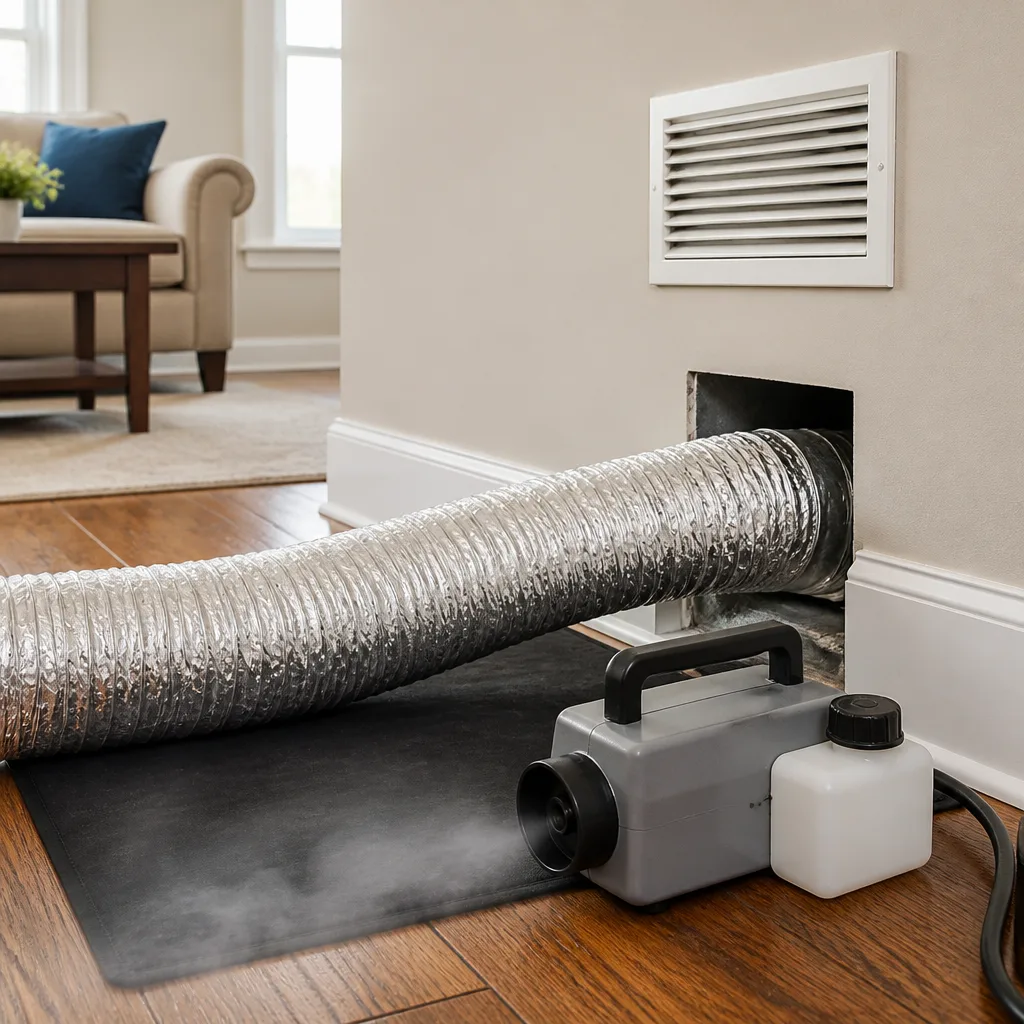 Sanitizing & deodorizing
Whole-system duct and dryer vent check with before-and-after photos - you see exactly what came out of your vents
That "$99 whole-house special" is a bait ad - the real number appears once they are in your hallway, or the "clean" is a shop-vac at the register. We photograph the inside of your ducts before and after instead.
How to Hire an Air Duct Cleaning Contractor in San Jacinto: A Step-by-Step Guide
There is no California state license for air duct cleaning. Not one. Anyone with a cargo van, a portable vacuum, and a basic website can legally advertise “professional duct cleaning” in San Jacinto tomorrow morning, and no state agency will stop them. This single regulatory gap explains why reviews for duct cleaners across the Inland Empire swing so wildly, from five-star transformations to stories about broken dampers and collapsed flex ducts that cost more to repair than the cleaning itself. In this guide, we’ll give you the exact technical vocabulary, equipment benchmarks, and contract safeguards to tell the difference between a specialist and a generalist with a vacuum, before you schedule, not after you’ve paid.
Quick Answer
To hire a legitimate air duct cleaning contractor in San Jacinto, ask three specific equipment questions before scheduling: what CFM rating their negative air machine carries, whether they use a rotary contact brush or air-whip only, and what filtration stage their vacuum exhaust passes through. Verify NADCA membership directly on the NADCA directory rather than trusting a website logo, require before-and-after camera documentation as a contract term, and treat any quote under $250 for a whole-home system as a likely bait-and-switch. Then call (866) 569-6948 for a free estimate from a San Jacinto contractor that runs Rotobrush and Nikro equipment on every job.
Styles & brands we work with
- Whole-home duct cleaning
- Dryer vent cleaning
- Camera inspection
- Sanitizing & deodorizing
Table of Contents
- Why the Licensing Gap Makes Hiring a Duct Cleaner in San Jacinto Different
- The Three Equipment Questions That Separate Specialists From Generalists
- Why NADCA Membership Matters (And How to Verify It’s Real)
- What a Legitimate Pre-Job Scope Looks Like
- Contract Terms That Protect You Before the Van Arrives
- Realistic Pricing in San Jacinto: What Drives Legitimate Cost Variation
- Red Flags That Should End the Phone Call Immediately
- The Step-by-Step Hiring Process: Your Pre-Screening Checklist
Why the Licensing Gap Makes Hiring a Duct Cleaner in San Jacinto Different
Most skilled trades in California carry some form of state-level credential. Electricians hold C-10 licenses through the Contractors State License Board. Plumbers carry C-36. HVAC contractors operate under C-20. You can look up any of them in a public database, verify their bond, and check for disciplinary actions. Air duct cleaning is not on that list. The CSLB does not issue a specific duct-cleaning classification, and no state agency requires a certification to clean residential ductwork.
What this means in practical terms for a San Jacinto homeowner is that the quality floor for this industry sits at absolute zero. There is no board to complain to when a cut-rate crew damages your flex duct and disappears. No licensing body to verify that the person you’re hiring has ever seen the inside of a duct system they didn’t install themselves. The only credential that carries real weight is voluntary: NADCA certification, which we’ll cover in detail below.
This regulatory vacuum also shapes the local market. San Jacinto sits in an HVAC-heavy region. Summers push temperatures past 100 degrees routinely, and the cooling season runs long. Homes built across the Hemet-San Jacinto Valley from the 1980s through the mid-2000s have duct systems that are now 20 to 40 years old. Flex duct in those attics has been baked, stretched, and chewed by rodents for decades. When a homeowner finally decides to clean, the system often needs more than surface agitation. It needs a contractor who can identify failing sections and address them. That’s why our scope of services includes Air Duct Repair in San Jacinto alongside cleaning. Not every situation is a cleaning-only situation, and a contractor who can’t tell the difference won’t serve you well.
The Three Equipment Questions That Separate Specialists From Generalists
Here’s the core of this guide. These three questions, asked in this order, will tell you more about a duct cleaning contractor in ninety seconds than two hours of reading online reviews. They’re technical, specific, and impossible to bluff through if you know what the answers should sound like.
Question 1: What CFM rating does your negative air machine carry?
CFM stands for cubic feet per minute. It measures how much air volume the vacuum system can move. Think of it as the difference between a drinking straw and a garden hose. Professional truck-mounted or large-portable negative air machines used in residential duct cleaning typically run between 1,500 and 5,000 CFM. The portable units a homeowner can rent at a hardware store max out around 400 to 600 CFM.
The CFM rating matters because duct cleaning is not just about loosening debris. It’s about creating enough negative pressure inside the duct system to pull loosened material back to the vacuum while preventing it from blowing into your living space. A low-CFM setup simply cannot maintain the pressure differential needed for complete extraction. The debris that doesn’t get extracted settles back into the ducts or, worse, gets pushed through the registers into your home. We run high-CFM Nikro HEPA-rated vacuum equipment on every job in San Jacinto because anything less means we’re not finishing the job we started.
If a contractor can’t answer this question, or answers with a vague “it’s powerful enough,” that tells you they’ve never thought about their equipment in technical terms. That’s the wrong person to trust with the inside of your HVAC system.
Question 2: Do you use a rotary contact brush system, or air-whip only?
Duct cleaning has two main agitation methods. Air-whip systems blow compressed air through a wand with flexible nozzles that “whip” the air in all directions. They can knock loose light dust and loose debris, but they make no physical contact with the duct surface. Anything adhered to the duct walls, such as caked dust from years of humidity cycles, construction dust from a renovation, or the film left by a previous home’s candles and cooking, stays put.
A rotary contact brush uses a rotating brush head driven by the vacuum system’s airflow to physically scrub the interior duct surface while extraction happens simultaneously. This is what the Rotobrush system we use does: mechanical agitation through direct contact, not just air movement. The distinction matters in San Jacinto specifically because our low-humidity summers combined with AC condensation create cycles of dust accumulation that hardens onto duct surfaces. An air-whip alone will not remove it. You’ll pay for a cleaning and still see dust re-emerging from your registers within weeks.
The right answer to this question includes the word “rotary” or “brush contact” or the brand name Rotobrush. The wrong answer is any version of “we use high-pressure air” with no mention of physical contact.
Question 3: What filtration stage does your vacuum exhaust pass through?
Here’s the part most homeowners never think about. Every vacuum system exhausts air somewhere. If the exhaust is unfiltered or passes through a basic bag filter, the finest particles, the ones most likely to trigger allergies or respiratory irritation, get blown right back into your home. You’re paying to remove particles and the machine is returning the smallest, most damaging fraction of them to your living space.
The professional answer is multi-stage filtration ending in HEPA. A proper setup has at least two stages: a primary filter for larger debris and a HEPA stage rated to capture 99.97% of particles at 0.3 microns. HEPA filtration is what separates a cleaning that actually removes allergens from one that just rearranges them. Our Nikro equipment exhausts through HEPA-rated filtration, which means what we capture stays captured.
When you ask this question, listen for specifics. “HEPA” should be in the answer. So should a particle-size number. If you get a blank pause, that’s your signal to end the call and try the next contractor on your list.
Why NADCA Membership Matters (And How to Verify It’s Real)
Since California doesn’t regulate duct cleaners, the industry’s only meaningful credential is membership in the National Air Duct Cleaners Association. NADCA maintains a code of ethics, publishes technical standards (the ACR, or Assessment, Cleaning, and Restoration standard), and requires member companies to carry at least one certified Air Systems Cleaning Specialist on staff. That certification requires passing an exam on the technical aspects of HVAC systems, contamination control, and cleaning methodology.
But here’s the part most guides skip: a logo on a website means nothing. Any contractor can copy a NADCA image and paste it into their footer. Verification takes thirty seconds. Go to NADCA’s directory at nadca.com, type in the company name, and confirm they appear. If they don’t show up in the directory, they are not members, regardless of what their website claims.
NADCA membership is not a guarantee of good work. We’ve seen member companies in the Riverside County market phone in jobs. But it’s a meaningful filter because it requires real financial investment and ongoing education that generalists with low-end equipment are unlikely to make. In a market as unregulated as San Jacinto duct cleaning, a verifiable NADCA membership card is the closest thing you’ll get to a license check. Ask for the company’s NADCA member number and verify it before you book anything.
What a Legitimate Pre-Job Scope Looks Like
A real duct cleaning professional doesn’t roll up to a San Jacinto home and immediately start pulling hoses. There’s a pre-job assessment that happens first, and you should be suspicious of any contractor who skips it. Here’s what a proper scope looks like before equipment gets unloaded:
- System walkthrough: The technician walks your home, checks the HVAC unit location, identifies the supply and return plenums, and notes where the air handler sits. They’re mapping the system, not glancing around. In San Jacinto’s typical single-story ranches and two-story tract homes built since the 1980s, this means locating return ducts in hallways and supplies in every room, including often-forgotten ones in closets and bathrooms.
- Register count: Every supply register and return grille gets counted and recorded. A legitimate quote is based on the actual number of registers and the system’s layout, not a generic “whole house” number. If a contractor hasn’t counted your registers, they don’t know what they’re bidding on.
- Duct material identification: The type of duct material matters. Sheet metal ducts respond differently to rotary brushing than plastic flex duct does. Older San Jacinto homes may have a mix: metal trunk lines with flex branches. A technician who doesn’t identify the material type before cleaning risks damaging flex duct with equipment designed for metal, or under-cleaning metal with gear calibrated for flex.
- Access point planning: The system needs to be accessed for cleaning. This usually means removing registers and possibly cutting a temporary access into a trunk line that gets sealed afterward. A proper pre-job assessment identifies how many access points are needed and where they’ll be placed. If the plan is to clean everything through existing registers only, you’re not getting a complete cleaning. The return side especially cannot be properly cleaned through a standard grille opening.
If the contractor can’t walk you through these four elements before they start work, they’re not doing a system-level cleaning. They’re doing a surface job and charging you for a system job. The Air Duct Cleaning in San Jacinto process we run always begins with this full assessment. It takes twenty minutes and it tells us exactly what we’re dealing with before any cleaning starts.
Contract Terms That Protect You Before the Van Arrives
The time to negotiate protections is before work starts, not after something goes wrong. A legitimate duct cleaning contract is short, specific, and includes at least these three clauses. If a contractor won’t put these in writing, walk.
Before-and-After Camera Documentation
You should see the inside of your ducts before and after the cleaning. Modern duct cleaning professionals run inspection cameras through the system and show you the before-and-after feed. Some capture still images or video segments. Our jobs include camera documentation of the duct interior as a standard part of the service, not an add-on. This is the you-should-demand benchmark: visual proof that the work was done, not a checkbox on an invoice. If a contractor can’t show you the inside of your ducts before and after, you have no way to verify anything happened.
Debris Containment and Guarding Language
The contract should state how the contractor will contain debris during cleaning and protect your home. Look for language about sealing register openings, covering entry points, and protecting your floors or walls from equipment movement. On our jobs, we follow Guardsman-grade protocols to protect duct surfaces and system components. If the contract says nothing about containment, assume dust will escape into your home and you’ll be cleaning every surface in every room afterward.
Mold or Damaged Duct Discovery Terms
Sometimes cleaning reveals problems: mold growth in a duct section, a disconnected branch, or flex duct that’s torn or collapsed. What happens then? A good contract states that if mold is discovered, the contractor will stop relevant work, document the finding, and discuss remediation options before proceeding. The same for damage: if the cleaning reveals a broken connection, a professional will quote the repair separately and get your approval before doing anything. Our service scope includes this scenario, which is why Air Duct Repair in San Jacinto is a distinct service line rather than an afterthought. The worst contracts are silent on this. That silence invites pressure sales when the technician “finds” something expensive mid-job.
Realistic Pricing in San Jacinto: What Drives Legitimate Cost Variation
Let’s talk actual money, because pricing is where San Jacinto homeowners get hurt most often. The $99 whole-house special is the classic bait in this industry. It’s also the single most reliable indicator that you’re about to get a high-pressure sales presentation instead of a real duct cleaning.
Here’s why. A legitimate whole-home duct cleaning requires a professional-grade negative air machine, a rotary agitation system, a trained technician, and three to five hours of labor depending on house size. Equipment costs alone run into five figures for the gear we use from Rotobrush and Nikro. No company covering those costs can clean a full system for $99 and stay in business. The math doesn’t work, which means the $99 quote is a loss leader designed to get a technician into your home where the “discovered problems” upsell begins.
So what should you expect to pay in San Jacinto? Here’s a realistic range based on what we see in this market:
- Small single-story home (under 1,200 sq ft, 6-10 registers): $300-$450
- Typical San Jacinto tract home (1,200-2,400 sq ft, 10-18 registers): $400-$650
- Large two-story or custom home (2,400+ sq ft, 18-30 registers): $600-$1,000
- Add-on services like dryer vent cleaning: $75-$150 as a standalone
- Duct repair or replacement sections discovered during cleaning: quoted separately, ranges widely by material and access
Legitimate price variation comes from three factors: system size (register count), duct material (metal cleans faster than old brittle flex that needs careful handling), and contamination level (pet hair, construction dust, and rodent activity all slow the job). Age matters too. A forty-year-old system with original flex duct requires slower, more careful brushing than a ten-year-old system with clean metal runs. None of these factors fit a flat $99 price point.
We quote one flat price per system before work starts. The price we quote is the price you pay, whether the job takes three hours or six. No per-register pricing, no mid-job discoveries that suddenly change the invoice. If a San Jacinto contractor’s pricing model relies on charging per-vent, that’s a redesign destined for pressure selling, not honest work.
Red Flags That Should End the Phone Call Immediately
You now have enough information to screen contractors quickly. Here are the deal-breaker signals that mean the right move is hanging up and dialing the next number on your list:
- The $99 flat-fee quote: As covered above, this is a sales tactic, not a real price. The company is paying to put a truck at your curb so a commissioned salesperson in technician’s clothing can tour your home.
- No answer to the CFM question: Any contractor who can’t state their vacuum system’s air-moving capacity is not running professional-grade equipment. Period.
- “We don’t need to access the return ducts”: Complete return-side cleaning requires access beyond the grille opening. A contractor who says otherwise is leaving half your system untouched.
- No camera documentation: In 2026, there is no legitimate reason a professional duct cleaner can’t show you before-and-after footage. If they can’t, assume they don’t want you to see something.
- Pressure to decide today: Real specialists don’t run one-day-only deals. A quote should be good for at least two weeks. Scarcity pressure exists to short-circuit your research process.
- NADCA logo that doesn’t verify: We covered this above but it bears repeating. Check the directory. A fake logo is an automatic disqualification.
- No contract or verbal-only terms: If they won’t put the scope, price, and documentation promise in writing, there is no scope, price, or promise. Nothing protects you.
The Step-by-Step Hiring Process: Your Pre-Screening Checklist
Here’s the entire process, condensed into a checklist you can use while you’re working through your options. This is the order we’d recommend to a San Jacinto neighbor asking us how to find the right contractor.
- Build a list of three to five contractors who serve San Jacinto. Sources: NADCA’s directory, personal referrals from neighbors, and local HVAC companies that offer duct cleaning as an integrated service.
- Call each one and ask the three equipment questions from the section above. Take notes. The ones who struggle don’t make it to step three.
- Verify NADCA membership for any company claiming it. The directory takes thirty seconds to search. If they’re not in it, they’re not members.
- Request a written estimate that includes register count, duct material type, access point plan, and a flat price for the complete system. Reject any quote that’s per-vent or carries a teaser flat fee under $250 for a whole home.
- Review the contract language for camera documentation, debris containment, and discovery terms for mold or damage. If any of these are missing, ask for them in writing before signing.
- Book the job and confirm the plan the day before. A professional service will confirm your appointment, the expected arrival window, and reconfirm the flat price. This is the point at which you can still adjust anything without cost.
We built our service around closing the gap this guide describes. The equipment questions we told you to ask are the questions we’d welcome anyone asking us. The contract terms we told you to demand are the terms we already include. And the pricing bands we shared are the bands we operate within for Dryer Vent Cleaning in San Jacinto and full air duct cleaning alike.
Common Mistakes to Avoid
- Hiring on price alone: The cheapest quote is not the best value. In San Jacinto’s unregulated market, it’s usually the most expensive per square foot of actual cleaning performed. A $99 job that cleans 30% of your system costs you far more than a $500 job that cleans 100% of it.
- Assuming “licensed and insured” means something for duct cleaning: California doesn’t issue a duct-cleaning license. A contractor can truthfully say “licensed” while holding only a business tax certificate that any resident can obtain. Insurance matters, but it’s not a proxy for technical competence.
- Skipping the register count: If you don’t know how many registers are in your system, you can’t evaluate whether the quote is complete. Count your registers before you even make the first call.
- Ignoring the return side: The return ducts carry the dirtiest, most allergen-laden air in your home. A cleaning that skips returns is not a cleaning. It’s a supply-side cosmetics job.
- Waving off camera documentation: The single most common regret we hear from San Jacinto homeowners who had a bad duct cleaning experience is that they never verified the work. Camera footage is the only way to know.
- Not asking about equipment before booking: Once the van is in your driveway, asking about CFM ratings is too late. You’ve already committed. Ask first, book second.
- Accepting a spike in price after work begins: “We found something and it needs attention” followed by a large unplanned invoice is the classic pressure-sale pattern. Legitimate contractors document findings, quote repairs separately, and get your sign-off before doing anything.
See the difference
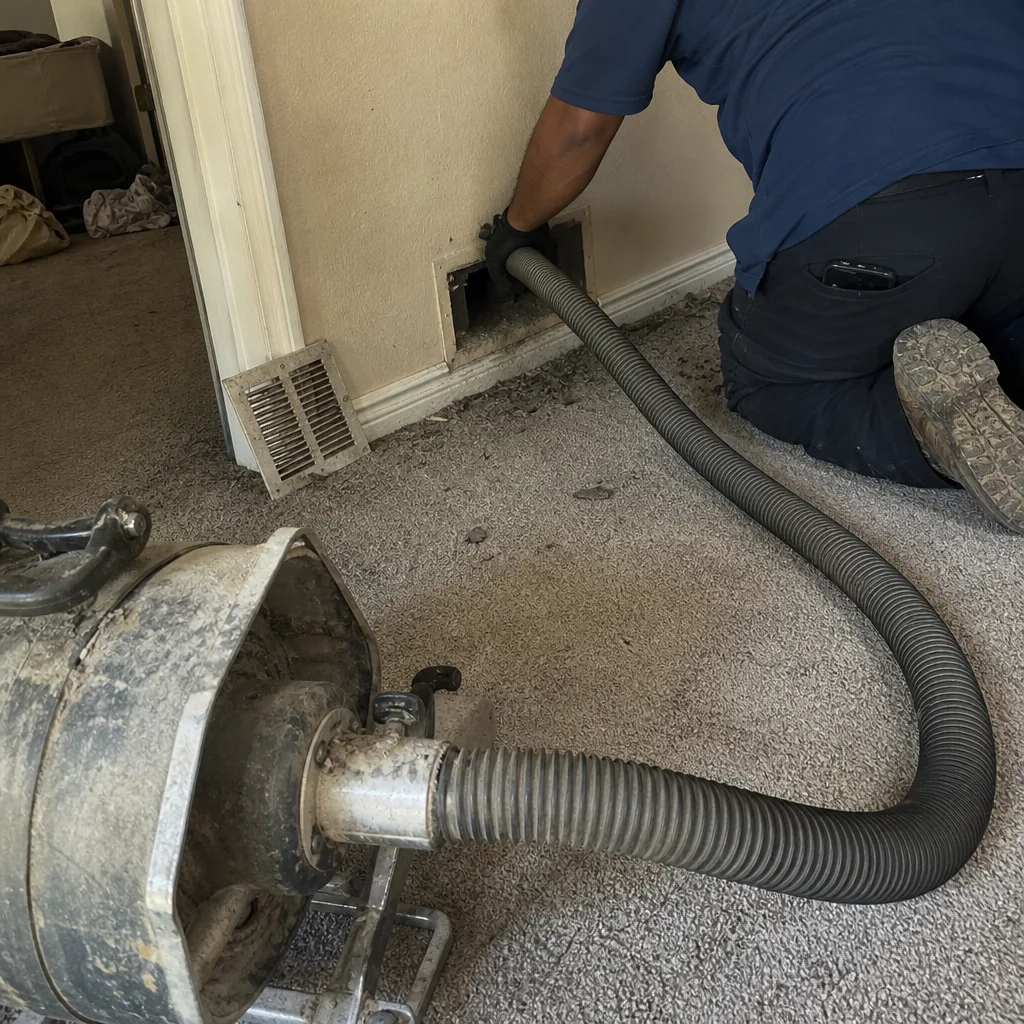 Before
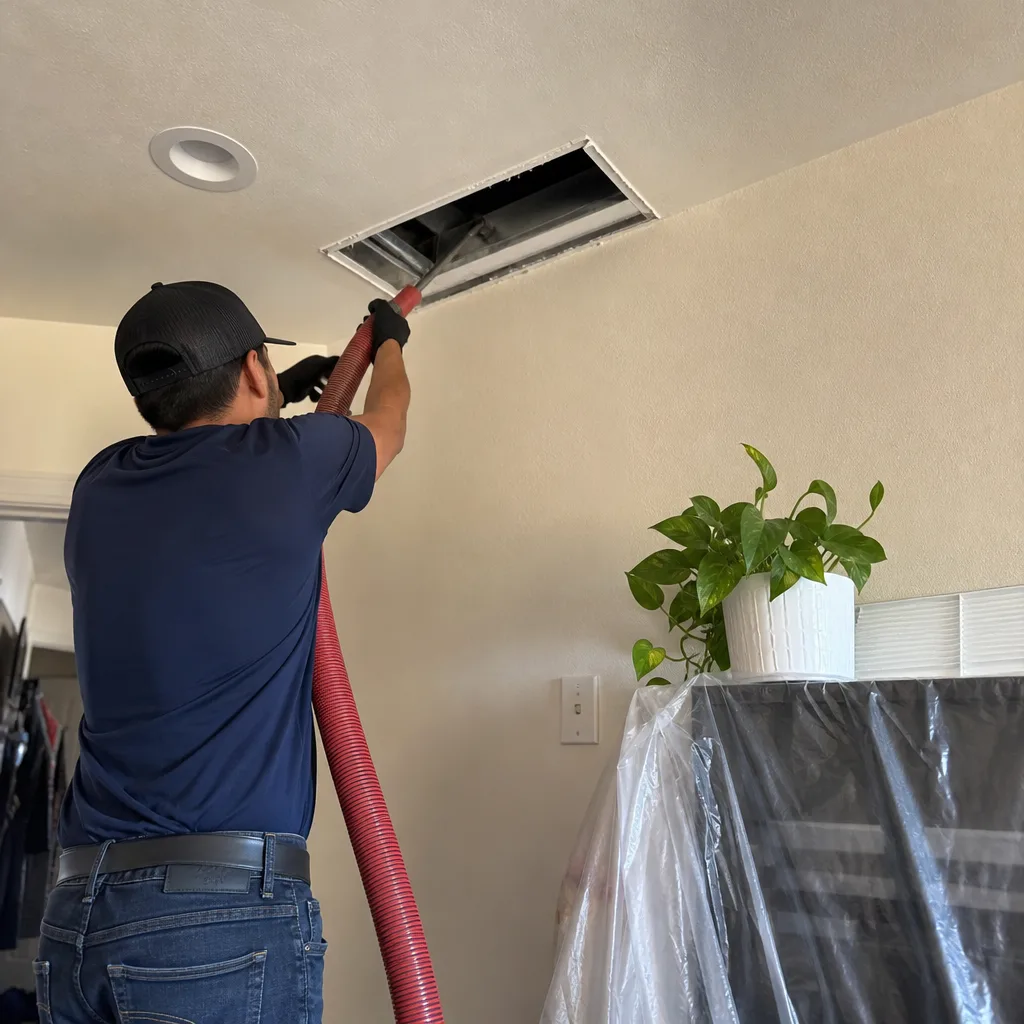 After
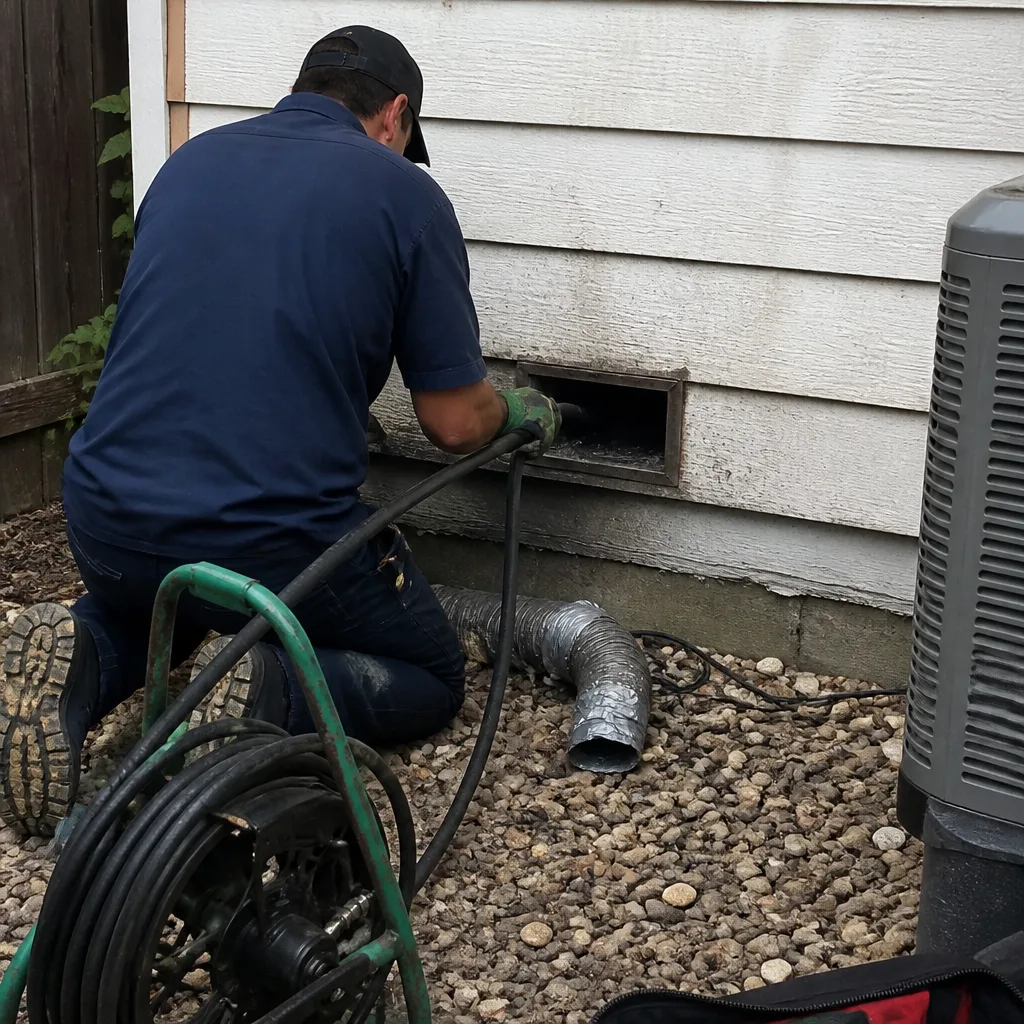 Before
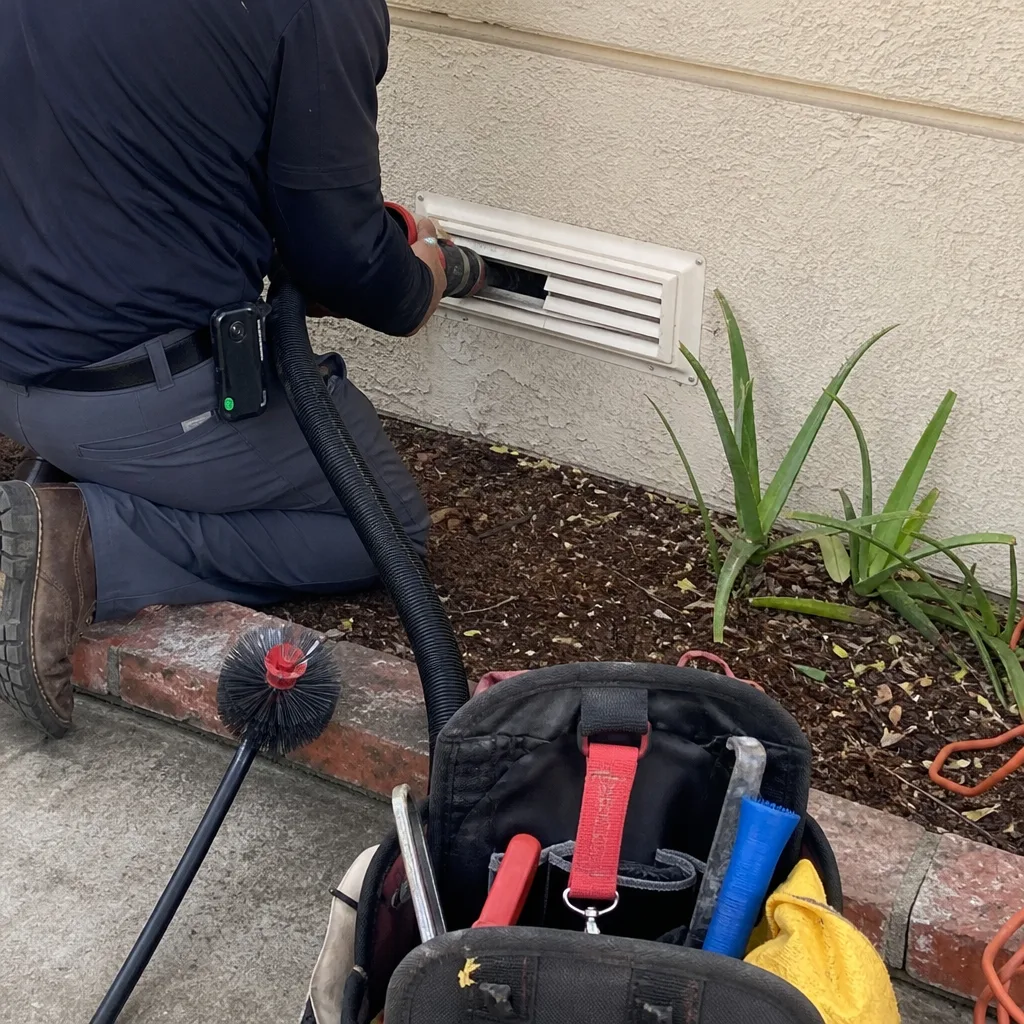 After
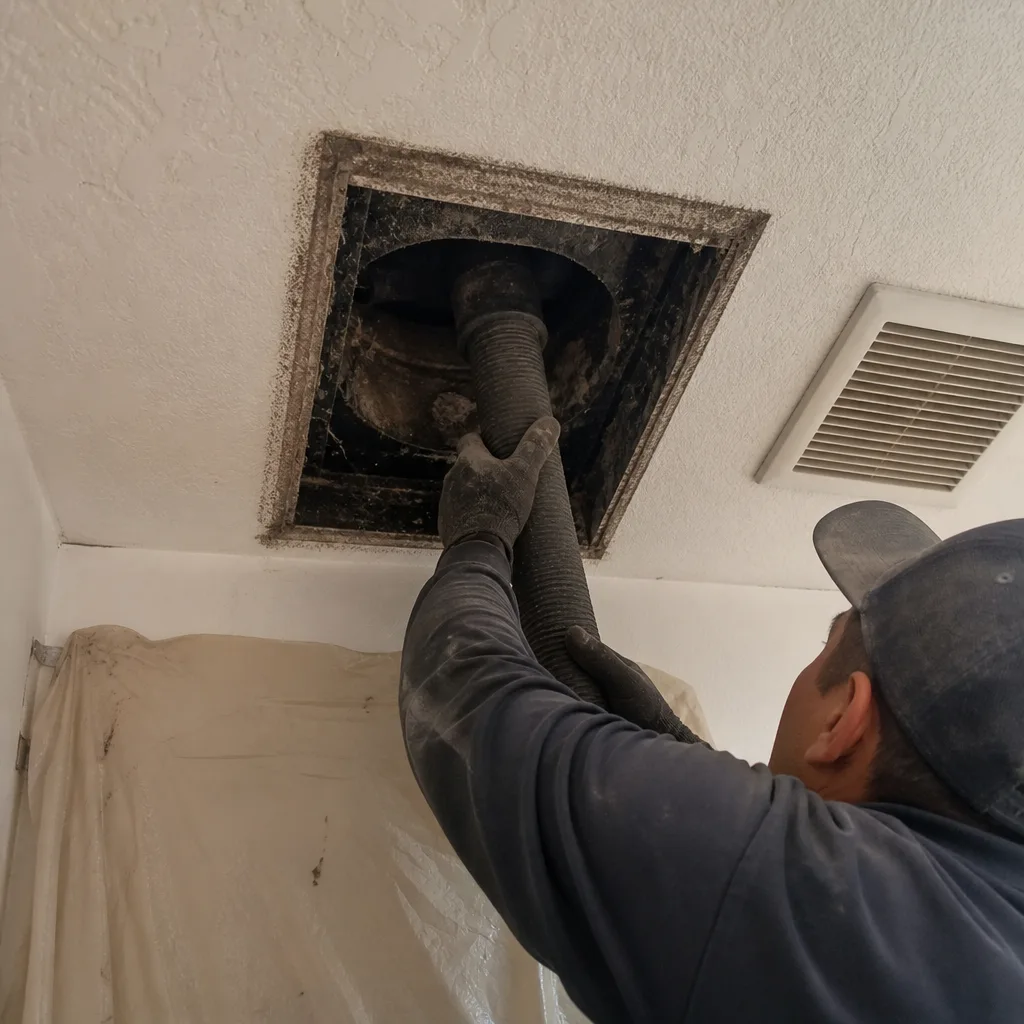 Before
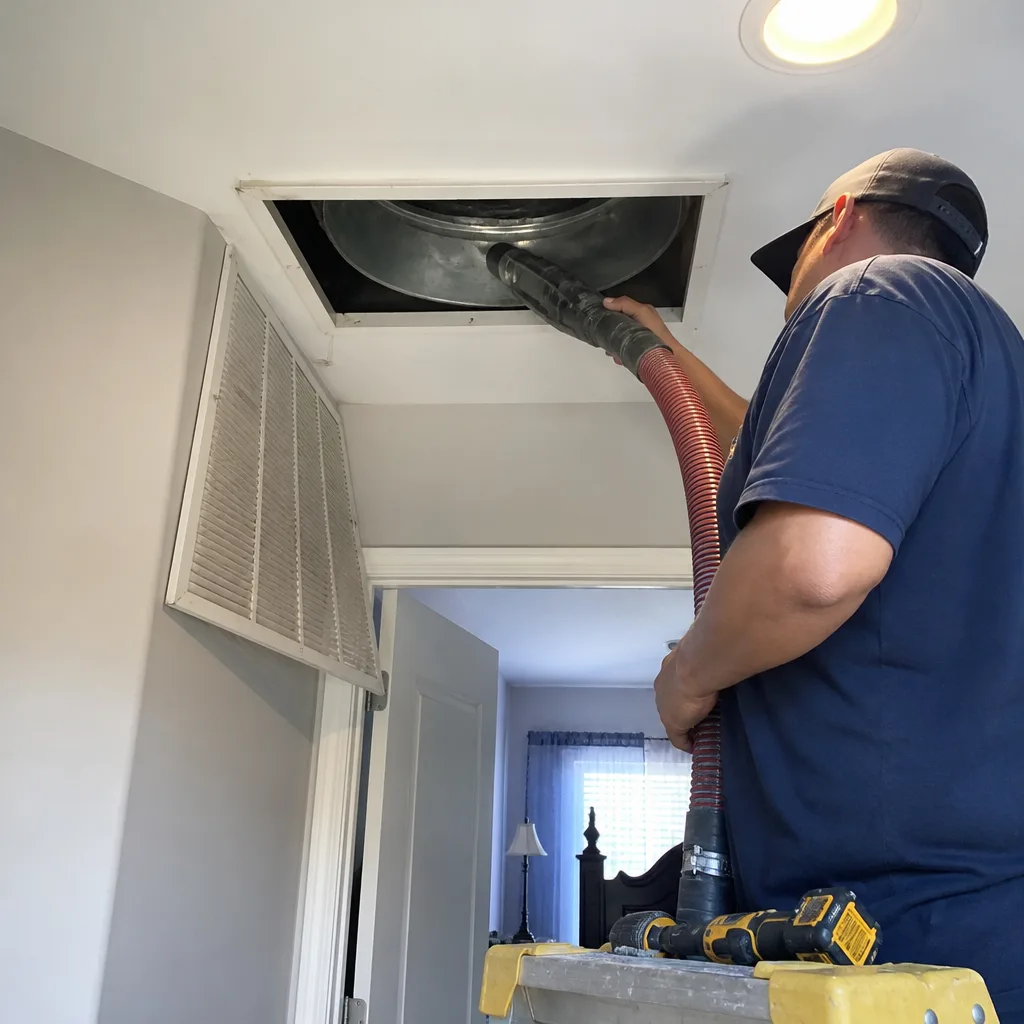 After
When to Call a Professional
Not every home needs duct cleaning on a strict schedule, but certain situations reliably call for it. If anyone in your San Jacinto household has recently developed unexplained allergy symptoms that improve away from home, that’s a signal. If you just completed a renovation and drywall dust settled through the system, that’s not a maybe, that’s a yes. If you’ve never cleaned the ducts in a home you’ve owned for more than five years, you’re overdue. If there’s been rodent activity in the attic, especially in older San Jacinto neighborhoods where field mice are common in cooler months, you need inspection and likely cleaning before you run the system again. And if your dryer vent hasn’t been professionally cleaned in over a year, that’s the dryer vent cleaning conversation, separate from the main duct system but just as important. Duct Cleaning San Jacinto offers free estimates in San Jacinto – call (866) 569-6948 for an honest assessment of your system based on what we actually find.
Frequently Asked Questions
A legitimate whole-home air duct cleaning in San Jacinto typically costs between $350 and $650 for a standard tract home with 10 to 18 registers, depending on system size and contamination level. Small single-story homes can run $300 to $450, while large two-story homes typically start around $600. Quotes under $250 are loss leaders designed to get a salesperson into your home, not a real price for a real cleaning. Call (866) 569-6948 for an exact flat-price quote based on your system.
Cheaper quotes almost always mean lighter equipment, faster work, and skipped steps. A $99 quote cannot cover the cost of proper negative air equipment, HEPA filtration, and a technician’s time, which means the company is either not doing a complete cleaning or planning to make their money on mid-job upselling once they’re inside your home. The price difference is usually a method difference: low-cost crews use air-whips and shallow extraction, while specialists use rotary contact brushing with high-CFM negative air machines.
Require before-and-after camera documentation as a contract term before you book. Professional duct cleaners run inspection cameras through the system and show you the duct interior before and after cleaning. If a contractor cannot or will not show you this footage, assume you cannot verify their work. This is a hard requirement, not an optional add-on. We include camera documentation as a standard part of every San Jacinto job.
Most homes in San Jacinto benefit from professional duct cleaning every three to five years, though homes with pets, allergy-sensitive occupants, frequent renovation projects, or rodent activity may need it more often. A home with a new HVAC system and no pets or construction history can reasonably go five years between cleanings. The best indicator is visual: when a professional inspection shows visible dust accumulation, it’s time.
Duct cleaning removes debris and contaminants, but mold growth inside ductwork requires specific remediation protocols that go beyond standard cleaning, including identification of the moisture source, antimicrobial treatment where appropriate, and in some cases duct section replacement. If a contractor discovers mold during a standard cleaning, the professional response is to document the finding, discuss options with you, and only proceed with remediation after you’ve approved a separate scope and price. Our equipment from Abatement Technologies supports the containment and air-scrubbing protocols required for higher-contamination environments.
No. The equipment and labor costs required for a real whole-home duct cleaning make a $99 price mathematically impossible without either cutting corners, skipping the return side, running air-whips only with minimal extraction, or planning an aggressive upsell once the van is at your door. Treat any whole-home quote under $250 as a marketing funnel, not a service price. The honest approach is a flat per-system price that reflects what the job actually requires, which is how we quote every job in San Jacinto.
The Bottom Line
Hiring a duct cleaner in San Jacinto requires knowing what good work looks like before you pick up the phone. Ask the three equipment questions: CFM rating, rotary brush versus air-whip, and HEPA filtration. Verify NADCA membership in the actual directory, not on a website logo. Demand a pre-job assessment that counts registers, identifies duct material, and plans access points. Get camera documentation, debris containment, and discovery terms in writing. And treat sub-$250 quotes as the sales funnel they are. When you’re ready to work with a contractor that runs Rotobrush and Nikro equipment, offers cleaning and repair in a single visit, and quotes one flat price per system, call (866) 569-6948 for a free estimate. Explore our Duct Cleaning San Jacinto home page to see our full scope of services, from air duct cleaning and dryer vent cleaning to air duct repair.
Written by the team at Duct Cleaning San Jacinto, serving San Jacinto since 2015.